Paul Romer sheds light on rules and development
In a great talk, economist Paul Romer proposes an interesting idea to create places of innovation and development. By the creation of charter cities, who have specifically defined rules and goals, new cities can be created where motivated people can move to that like to work and live in those cities. The idea is inspired […]
Good intensions
Giving aid is a difficult dilemma. A Samaritan’s dilemma. There are different ways to help the poor in developing countries. Beyond Good Intensions provides a series of videos from aid projects all over the world to find out what works and what does not. It also provide an option to discuss the problem of aid […]
Institutional context and how good people turn evil
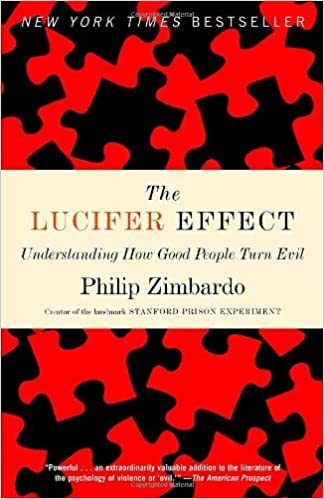
Philip Zimbardo, an emeritus professor of social psychology from Stanford University, did in the early seventies a famous experiment where a group of young men randomly were assigned to be prisoner or guard. The Stanford Prison Experiment (SPE), as it is known know, was cancelled after a week when a collegue of Zimbardo who saw […]
Nudging
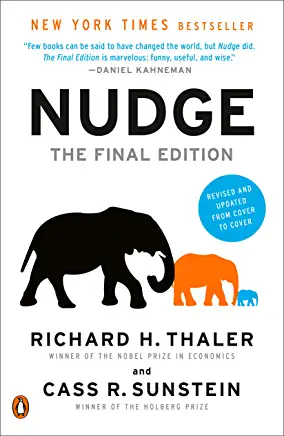
An interesting book of 2008 is Nudge by behavioral economist Richard Thaler and legal scholar Cass Sunstein. Based on behavioral studies they discuss incentives structures for many different topics. Thaler and Sunstein introduce the term choice architecture to refer to carefully designed incentive structure that gently push the people into desired chosen. From empirical studies […]
Plastic brains
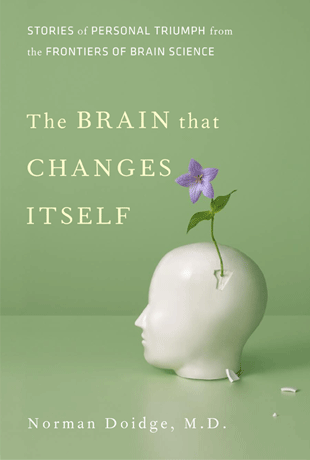
Just finished “The brain that changes itself” of Norman Doidge which discuss new developments in brain research. Mainly the findings that brains can adapt to lost functions. Many examples are discussed of people who lost brain function due to stroke, or had only half a brain, and were able to train other parts of the […]
The benefits of theft
Stealing somebody’s property is illegal, but sometimes it has benefits and is tolerated. Within the increasing digital world copying software and other digital products is easy to do. The Economist of July 19th discusses some cases where one likes to benefit from piracy. For example, for each music track that is legally exchanged, 20 music […]
Evidence-based Policy-making
In the May 24 edition of the New Scientist there is an article on the use of objective statistical analysis to investigated the effectiveness of policies, evidence-based policy similar to evidence-based medicine. Using randomized tests the effectiveness of various policies can be tested, although policy-making may not want to change their policies because of ideological […]
Predictably irrational
I just finished a fantastic book by Dan Ariely of MIT on Predictably Irrational: The Hidden Forces that Shape our Decisions. The book describes a large number of experiments in behavioral economics and psychology how on first site irrelevant factors have a major role in the outcomes in decision making experiments. Whether decisions are framed […]
The rules of gangs
A great book on the political economy of gangs is written by Sudhir Venkatesh in “Gang Leader for a Day”. In this book Sudhir reports on his adventures as a Chicago graduate students studying the activities of a gang. He got access to the innerworkings of the gang by getting the interest of gangleader JT. […]
Language and Institutions
In the edition of January 22 of PNAS Steven Pinker and colleagues discuss the “logic of indirect speech”. “When people speak, they often insinuate their intent indirectly rather than stating it as a bald proposition.” This is interesting from an institutional perspective. When people interact in open societies how do they know the intent of […]